
Why IS 9457 Is Critical for Indian Safety Compliance
At Shree Lisha Safety, we believe safety signage is more than a compliance requirement, it is a critical component of an organization's safety culture. By adopting IS 9457, businesses can improve hazard communication, strengthen emergency preparedness, and create safer workplace.
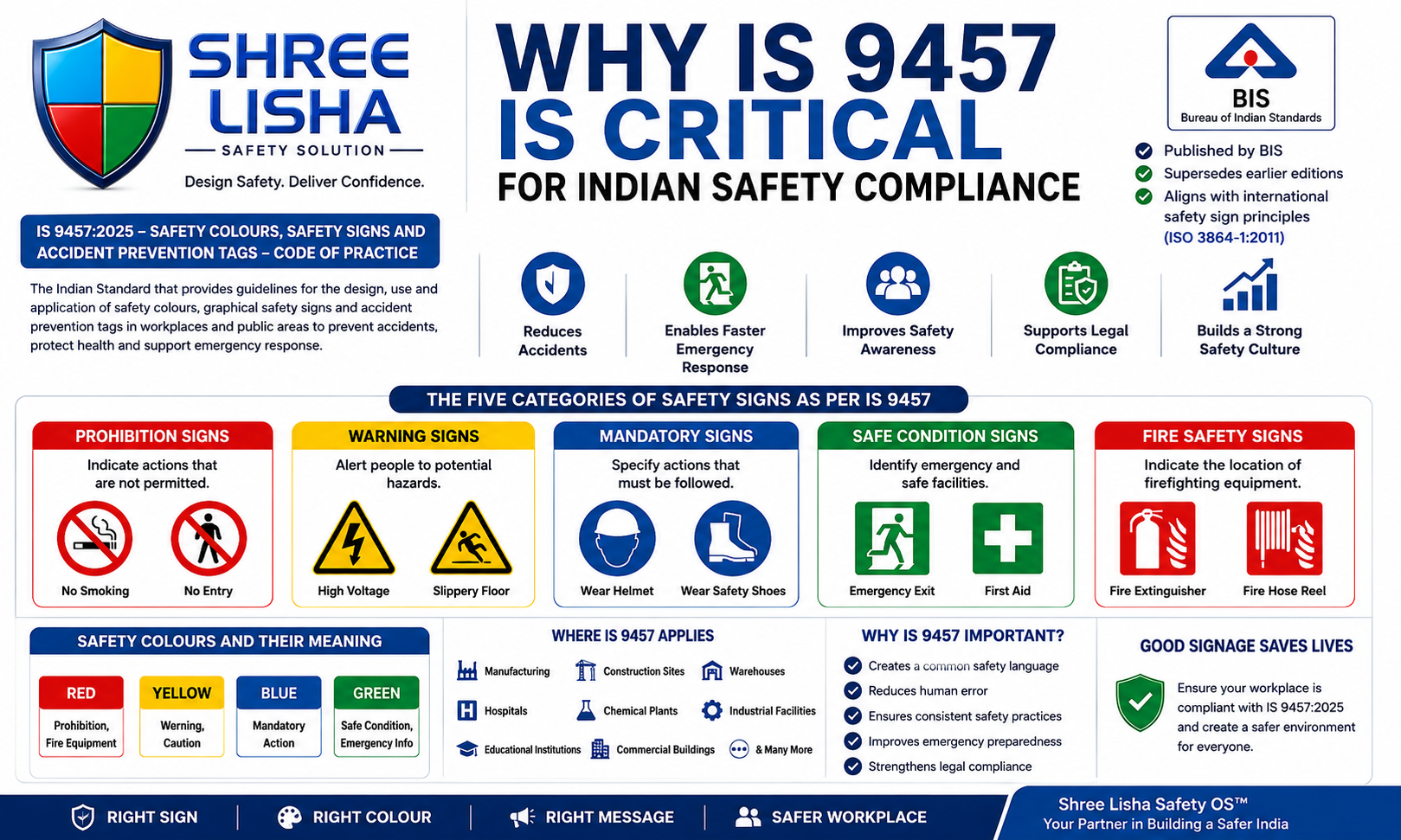
Building Safer Workplaces Through Standardized Safety Signage
Every workplace has hazards. Whether it's a manufacturing plant, warehouse, construction site, hospital, or commercial building, the ability to communicate those hazards quickly and effectively can make the difference between a safe workday and a serious accident.
This is where IS 9457:2025 – Safety Colours, Safety Signs and Accident Prevention Tags – Code of Practice becomes essential. Published by the Bureau of Indian Standards (BIS), IS 9457 provides a standardized framework for designing and implementing safety colours, safety signs, and accident prevention tags across Indian workplaces. It supersedes earlier editions of the standard and aligns Indian practices with internationally recognized principles for safety communication.
Why Do Safety Signs Matter?
Imagine a maintenance technician entering a restricted electrical room. There may not be enough time to read lengthy instructions, but a clearly visible Danger – High Voltage warning sign instantly communicates the risk.
Similarly, during a fire emergency, employees instinctively look for Emergency Exit, Fire Extinguisher, or Assembly Point signs. These signs are effective because they use universally recognized colours, symbols, and layouts that people can understand at a glance.
Safety signage is more than a regulatory requirement—it is one of the simplest and most effective engineering controls for preventing accidents and guiding people during emergencies.
What Is IS 9457?
IS 9457 is India's code of practice for the use of:
-
Safety colours
-
Safety signs
-
Accident prevention tags
The standard establishes design principles that promote consistency across workplaces, ensuring that safety messages are easily recognized regardless of industry or location.
Its primary objective is to improve workplace safety by providing a common visual language for communicating hazards, mandatory actions, emergency information, and fire safety equipment.
Where Does IS 9457 Apply?
The standard is applicable across a wide range of industries and facilities, including:
-
Manufacturing industries
-
Warehouses and logistics facilities
-
Construction sites
-
Chemical plants
-
Commercial buildings
-
Educational institutions
-
Healthcare facilities
-
Power plants
-
Industrial workshops
It is not intended for road traffic signs, railway signalling, aviation, or maritime navigation, which are governed by separate standards.
Why IS 9457 Is So Important
1. Creates a Universal Safety Language
India's workforce is diverse, with employees speaking different languages and coming from varied educational backgrounds.
A standardized graphical safety sign communicates its message instantly without relying solely on written text. This improves understanding for employees, contractors, visitors, and emergency responders alike.
2. Reduces Workplace Accidents
Many workplace incidents occur because people fail to recognize hazards or follow required safety procedures.
Properly designed safety signs help workers:
-
Identify hazardous areas
-
Follow mandatory PPE requirements
-
Locate emergency exits
-
Find firefighting equipment quickly
-
Avoid prohibited activities
Clear visual communication significantly reduces the likelihood of human error.
3. Supports Faster Emergency Response
During emergencies, confusion costs valuable time.
Proper emergency signage enables occupants to quickly locate:
-
Emergency exits
-
Fire extinguishers
-
Fire alarm call points
-
First-aid stations
-
Assembly points
Well-designed signage improves evacuation efficiency and supports emergency response teams.
4. Promotes Consistent Safety Practices
Without standardized guidelines, organizations often use inconsistent colours, symbols, and terminology across different facilities.
IS 9457 ensures that safety signs maintain a consistent appearance and meaning, making workplaces easier to navigate and safer for everyone.
Understanding the Five Categories of Safety Signs
IS 9457 classifies safety signs into distinct categories based on their purpose.
🔴 Prohibition Signs
These signs indicate actions that are not permitted.
Examples include:
-
No Smoking
-
No Entry
-
Do Not Operate
-
No Mobile Phones
🟡 Warning Signs
Warning signs alert people to potential hazards.
Common examples include:
-
High Voltage
-
Toxic Chemicals
-
Slippery Floor
-
Forklift Operating Area
These signs encourage people to exercise caution before entering hazardous areas.
🔵 Mandatory Signs
Mandatory signs specify actions that must be followed.
Typical examples include:
-
Wear Safety Helmet
-
Wear Eye Protection
-
Wear Respiratory Protection
-
Safety Shoes Must Be Worn
These signs are commonly found in industrial and construction environments.
🟢 Safe Condition Signs
These signs identify emergency facilities and safe locations.
Examples include:
-
Emergency Exit
-
First Aid
-
Assembly Point
-
Emergency Shower
-
Eye Wash Station
Their purpose is to guide occupants to safety during emergencies.
🔴 Fire Safety Signs
Fire safety signs identify the location of firefighting equipment.
Examples include:
-
Fire Extinguisher
-
Fire Hose Reel
-
Fire Alarm
-
Fire Control Room
These signs enable faster identification of emergency equipment during fire incidents.
Why Safety Colours Matter
Safety colours are not chosen for appearance—they communicate specific meanings.
Colour Meaning
🔴 Red Prohibition and fire equipment
🟡 Yellow Warning or caution
🔵 Blue Mandatory instruction
🟢 Green Safe condition and emergency information
Using incorrect colours can confuse workers and reduce the effectiveness of safety communication, particularly during emergencies.
Beyond Compliance: Creating a Safety Culture
Installing compliant safety signs should not be viewed as merely satisfying a regulatory requirement.
Effective organizations use safety signage as part of a broader workplace safety culture that includes:
-
Risk assessments
-
Employee safety training
-
PPE compliance
-
Emergency preparedness
-
Periodic safety audits
When combined with these measures, standardized signage becomes a powerful tool for reducing workplace injuries and improving operational safety.
Choosing Quality Safety Signage
Not all safety signs deliver the same level of performance.
Organizations should ensure that signage is:
- Designed according to applicable standards
- Manufactured using durable materials
- Suitable for indoor or outdoor environments
- Clearly visible from appropriate viewing distances
- Properly installed and regularly maintained
Faded, damaged, or poorly positioned signs can undermine workplace safety.
Conclusion
Workplace safety depends on clear, consistent communication. IS 9457 provides Indian organizations with a practical framework for using safety colours and safety signs that are instantly recognizable and easy to understand.
By implementing signage in accordance with IS 9457, businesses can improve hazard communication, strengthen emergency preparedness, and create safer working environments for employees, contractors, and visitors.
At Shree Lisha Safety OS™, we believe that effective safety signage is more than compliance—it's an investment in protecting people, improving workplace awareness, and building a stronger culture of safety.
References
-
Bureau of Indian Standards (BIS). IS 9457:2025 – Safety Colours, Safety Signs and Accident Prevention Tags – Code of Practice.
-
ISO 3864-1:2011. Graphical symbols — Safety colours and safety signs — Design principles for safety signs and safety markings.
-
Occupational Safety, Health and Working Conditions Code, 2020, Government of India (supports the broader legal framework for workplace health and safety, while IS 9457 provides guidance on safety signage design and application).
Note: While IS 9457 is the primary Indian standard governing safety colours and safety signs, organizations should also ensure compliance with applicable industry-specific regulations, state factory rules, and other relevant BIS standards depending on the nature of their operations.